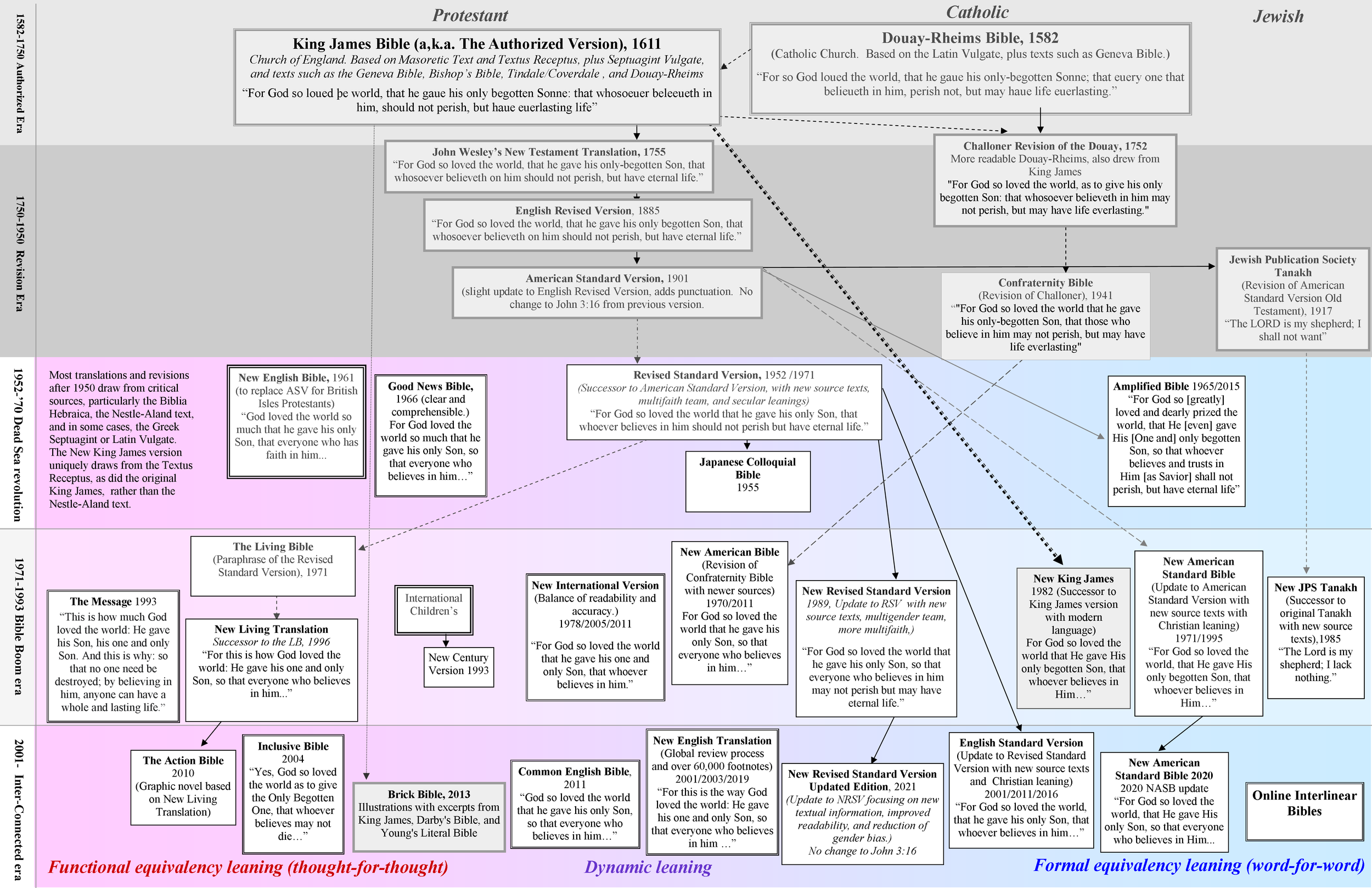
Why I use Six Translations
This Is Why I
-Preach from the NRSV,
-Study from the Tanakh,
-Reference the ESV,
-Give Out the CEB,
-Compose from The Message,
and Still follow King James
NIV
There's a silly church camp song that goes, "Mr. Postman, bring to me, a copy of the NIV — can't stand to wait any longer, I need the Bible to grow stronger."
That's about as much translation education as most of us got.
No complaints from me though.
Here's the New International Version (NIV) ’s rendering of Romans 8:28:
And we know that in all things
God works for the good of those who love him,
who have been called according to his purpose
RSV
Growing up, we had different translations around the church. King James, NIV, Revised Standard. I didn't really know what set them apart, except that the old-sounding ones must be older.
The New International Version (NIV) is what our Sunday school teachers gave us. The Revised Standard Version (RSV) is what was in the pews:
We know that in everything
God works for good with those who love him,
who are called according to his purpose
NKJV
The New King James (NKJV) was in the youth room. Nobody explained why, and it didn't matter. It worked for us.
And we know that all things work together for good
to those who love God,
to those who are the called according to His purpose.
Sometimes on trips I'd meet other young Christians who had only one translation and could quote long passages from it. That worked too. And it was different from what I knew — a different relationship with the text, built around depth in one version rather than casual exposure to several. I noticed that, even if I didn't have language for it yet.
NLT
The one that really got me was a New Living Translation (NLT) devotional study Bible. Something about that translation connected with my sixteen-year-old brain in a way the others hadn't. The NLT is where Scripture stopped belonging to my church and my teachers and started belonging to me. Consider the sample passage, Romans 8:28:
And we know that God causes everything to work together
for the good of those who love God
and are called according to his purpose for them.
As we drift away from formal accuracy, the NLT offers something special. Most translations render this with something like "called according to his purpose." The NLT uniquely adds "called according to his purpose for them." Two words. A pastoral addition. God has a purpose for these people, not just a purpose they need to fit inside. That's the rendering my teenage brain absorbed, and it's still the one that surfaces first. Is that what I see in most other translations? No, and that's alright.
NRSV
In college and seminary, I came to read and preach from the New Revised Standard Version (NRSV) — well regarded across academic and liturgical aisles, reliable on a tight week, unlikely to surprise me with a questionable rendering mid-sermon.
We know that all things work together
for good for those who love God,
who are called according to his purpose
The NRSV became my working translation, the one I could count on. It still is. Steady, trustworthy. It does the job without drawing attention to itself, which is exactly what I need when I'm the one doing the interpreting out loud. When I'm going to camp, I always bring my HarperCollins with all the study notes, and an NRSV Catholic Edition with the extended Canon.
If I had to choose one translation, I would choose the NRSV Catholic Edition.
However, sometimes, I just need something… easier.
The Message
Especially when we get to the Prophets. I just have to set the NRSV aside for a moment and consult The Message, or go back to my old best friend the NLT, because otherwise I genuinely cannot comprehend what's happening in the passage.
Meanwhile, the moment we get tired in the waiting, God's Spirit is right alongside helping us along. If we don't know how or what to pray, it doesn't matter. He does our praying in and for us, making prayer out of our wordless sighs, our aching groans. He knows us far better than we know ourselves, knows our pregnant condition, and keeps us present before God. That's why we can be so sure that every detail in our lives of love for God is worked into something good.
In my practice, The Message is an irreplaceable preaching resource that pairs beautifully with the NRSV.
CEB
All of this being said, when the opportunity arises, I almost always give the Common English Bible (CEB) to students, because it's genuinely good and readable. It uses clear, modern English and builds on excellent biblical scholarship.
We know that God works all things together
for good for the ones who love God,
for those who are called according to his purpose.
The CEB makes some choices that lean toward accessibility and accuracy, maybe at the expense of familiarity. For example, the CEB tends to render bar enasha as "the Human One" instead of "Son of Man." It's more accurate, but it's jarring for my ears. It disrupts my expectations. I'll be honest: my own crusty mind struggles with the cadences in the CEB. But I don't want younger readers inheriting my limitations. I want them to have a shot at encountering the text with fewer inherited assumptions, and the CEB gives them that.
JPS
And then there are the two translations that changed how I think about all the others.
The JPS Tanakh is a Jewish translation of the Hebrew Bible. It begins and ends with different sets of theological assumptions than the translations we find in most churches.
Consider Genesis 1:1. We're used to something like: "In the beginning, God created the heavens and the earth." The Tanakh offers: "When God began to create the heaven and the earth."
This matters because one of the deepest and least-examined habits in Christian Bible reading is supersessionism: the assumption that the Hebrew Bible exists primarily as a prelude to the Christian story. That assumption shapes how we translate, how we organize, how we teach, and how we read.
I start with the JPS Tanakh when I can, because it shakes loose my assumptions and expectations, and helps me to study Scripture with a freshened perspective.
ESV
The English Standard Version (ESV) does something different but equally helpful. It leans formal, and that formality preserves ambiguities that smoother translations quietly resolve.
And we know that for those who love God
all things work together for good,
for those who are called according to his purpose.
I can't exactly tell you why I check the ESV, but I think it adds something to my relationship with Scripture and my Wesleyan siblings in different areas.
So that's how I tend to approach things right now: start with the Tanakh, build with the NRSVUE, comprehend with The Message and the NLT, adjust with the ESV, share through the CEB.
KJV
But. When it comes to the clinical setting… it’s usually OK to set most of that down.
Theory is for the classroom and the spaces in between visits.
I've never met a patient who knew how to choose their favorite translation for the moment.
Sometimes I'll ask a few questions, try to assess whether a particular translation is more appropriate. Usually it doesn't matter.
Because when it comes to soothing the souls and hearts of patients who no longer speak,
there is almost nothing that lands like the King James Version of Psalm 23.
“The Lord is my shepherd; I shall not want.”
This passage does something special.
As it reads,
Heart rates regulate. Speech patterns emerge. Families see signs of life.
Is the King James accurate or readable?
Well… let me tell you this, the King James is magical.
Translation Plurality:
a crisis and an opportunity.
The fact that we have so many translations is beautiful.
Is there any chance that one English translation can fully capture texts written in ancient Hebrew, Greek, and some Aramaic?
No.
We need multiple translations.
We've always needed multiple translations.
Our traditions craved it. We needed different Gospels, different Talmuds, different witnesses to the same events. The impulse to hold multiple accounts of the same truth is written into the DNA of our scriptures themselves.
When we use translations unaware, when pastors don't know the differences, when Sunday school teachers hand out Bibles without context, when someone quotes a verse like a closing argument without realizing they're quoting one team's interpretive decision — that's when it becomes a senseless conflict. An embarrassment, honestly. Not because anyone means harm, but because we're holding an extraordinary resource and treating it like it's all one thing.
But when we use translations together — when we set them side by side and watch how each one lights up a different facet of the same passage — it's really something. It's the closest thing we can do to reconstructing a living, three-dimensional picture from thousands of years ago. Each translation is an angle. Each angle catches something the others miss. And together, they give us back a depth that any single rendering necessarily flattens.
That's not a crisis of authority. That's a gift of dimensionality. And it's one we can be teaching, celebrating, and using.
So learn your translations. Teach your people which ones do what and why. Account for your own defaults. Watch for supersessionist assumptions you didn't know you'd inherited. Build a literacy around the plurality rather than ignoring it.
The story is still ours. Every translation carries a piece of it. We just have to learn which piece is which — and when to set them all aside and let the oldest words in the room do what they've always done.
Hope Hilton MDiv