
Jesus Said "Don't Look Back." He Didn't Say "Don't Think." Here's What the Plow Actually Means.
(Hey secular scholar friends, this one’s for the insiders, but I welcome your feedback and critiques now and always.)
When Jesus says that
anyone who puts a hand on the plow and looks back is not fit for the kingdom of God (Luke 9:62),
it sounds harsh.
Maybe it is.
But the plow metaphor is doing something specific — and it's not telling you to abandon your family without warning or surrender your brain at the door. A plow requires sustained attention, active decision-making, and constant correction. Discipleship, it turns out, is not passive. It is one of the most demanding forms of agency there is.
Before we get to the plow, we need to know where we are. Because Luke cares about where we are.
Luke's Gospel, combined with Acts, tells the story of God's mission expanding in concentric circles — Jesus, then family, then the temple in Nazareth, then Galilee, then Samaria, then Jerusalem, then Corinth, Philippi, Ephesus, Greece, and finally Rome. And now across the planet. Luke-Acts is the story of a movement that began in a very particular place and expanded beyond every tribal and national boundary.
In this passage, we're in Samaria. That matters.
The Samaritans and the Judeans were not as different as people tend to assume. They worshiped the same God. They revered the same Scriptures. They were descendants of the same ancient Israelite kingdom. The eagles that soared over Samaria were the same ones that flew over Judea.
But they were politically divided. The Assyrian Empire had toppled the old united kingdom, and the two communities drifted apart. The Macedonian conquest under Alexander wedged them further. Roman occupation further still. By Jesus's time, they were two ethnic groups — largely related, able to intermingle, but separated by political forces, religious differences, and the desire to be seen as legitimate.
And the reason Jesus is in Samaria at all is practical:
you have to pass through it on the way to Jerusalem for Passover.
The mission is already expanding. The concentric circles are already widening.
Now — when Jesus taught about the kingdom of God, he was not talking about heaven after you die.
He was describing something that exists in contrast to the kingdoms already in place.
The kingdom of Judea. The empire of Caesar.
Rome was a totalizing social system. It controlled and utilized every aspect of daily life for the average person, whether they liked it or not. The structure was built on wealth, commerce, and war, governed by the will of Caesar.
It was not just illegal to eat with people of different classes — it was unimaginable.
By contrast, Jesus offered a radically alternative social movement. An opt-in structure where God's will would be done on earth as it is in heaven. A way of being where people would give generously, heal boldly, and — most radically of all — eat together.
Nowadays it's easy to imagine eating across social classes. We do it all the time. But we do it because that's been part of our spiritual heritage for two thousand years. We're able to imagine eating together because we follow someone who imagined it first.
Jesus taught about this movement in metaphors: a sheep that is found, a coin that is recovered, a family reunion, a banquet of delighted strangers.
Another metaphor he used was "kingdom," because that was the totalizing social structure everyone understood. He used the language of empire to describe something that subverted empire from the inside out.
Including ours. Including now.
And he did not sugarcoat the fact that it's hard work.
While Jesus is in a Samaritan village, someone approaches and asks to follow him. This deserves a moment of clarity about what "follow me" meant.
In Jesus's day, when a rabbi said "follow me," he was saying: leave it all behind. Your job, your family, your hobbies — and there were no phones, no reliable postal service. To follow a rabbi like Jesus was to give up your ego, your ambitions, your grudges. Even your most fundamental beliefs about how the world works.
This person says: Teacher, I'll follow you. Just let me tie up some loose ends.
Honestly? I feel for this person. It's a reasonable ask. Before I give everything, let me say goodbye to my old life.
We all have loose ends that mean a lot to us.
Jesus does not reject this person for ethnic or cultural differences — which matters, given that we're in Samaria. But he does turn down the request:
"No one who puts a hand to the plow and looks back is fit for the kingdom of God." (Luke 9:62)
When I first sat with this verse, the plow imagery stuck in my head like an unsolved puzzle. I knew there was something there, but however I turned it around, I couldn't quite see it.
I think that's what Luke is going for. Luke likes to give us puzzles so we can gain insight through the process of trying to solve them.
So here's the puzzle: A person who puts a hand on the plow and looks back is not fit for the kingdom of God. What does the plow mean?
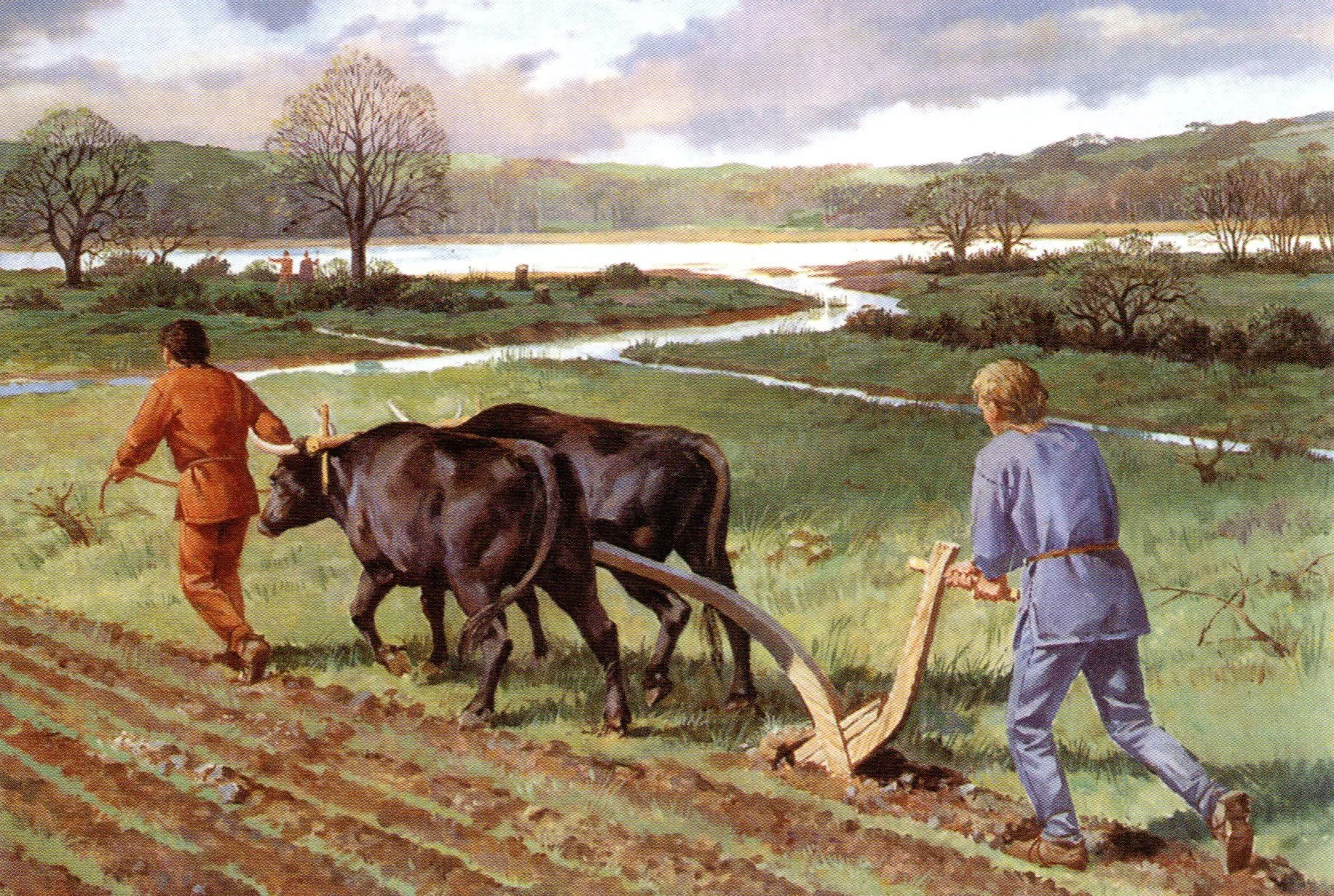
Think about an ancient scratch-plow. You attach it to a pair of oxen and drag it through the soil to make a shallow trench for planting seed. And it is not easy.
You have to keep both oxen moving in the same direction at the same speed. You have to keep the scratch-plow flowing in a straight line, parallel to the previous row. You have to keep it from tipping over, pivoted so it makes contact with the soil at exactly the right angle. And if you lose focus for just a moment — if you let one ox slow down just a little — you get curves. You get circles. And getting oxen back on the line is not a small correction.
Do you push through while the sun beats down? Do you start over the next day? How does this affect the crop's yield?
Some things require sustained, active attention. The plow is one of them.
Here's what the image reveals: to take up the plow, you have to be a dedicated follower behind the oxen and a focused leader at the same time. Your focus matters. Your attention matters. Your action matters. Discipleship is not passive obedience. It is responsibility. It is stewardship of a power far greater than any one of us.
If there was ever a single person who literally saved the world, it was Stanislav Petrov.
Petrov was an officer in the Soviet Air Force. In September 1983, the United States and the Soviet Union were locked in a condition of mutually assured destruction. Petrov's job was to monitor a screen — part of the Soviet missile detection system. If incoming missiles appeared, he was supposed to make a phone call. His superiors would launch a nuclear retaliation. The floodgates would open.
On that September day, Petrov's display suddenly flashed and beeped, warning of five incoming nuclear missiles from the United States.
But Petrov had a feeling something wasn't right. A fifty-fifty feeling. He disobeyed orders and reported that the system was showing a false positive.
The Cold War remained cold.
Stanislav Petrov was a relatively insignificant person on the world's stage. No political power. No celebrity. No wealth. But he kept his hand on the plow. He kept his focus forward. He was ready to act, and when the time came, he trusted his perception and literally averted nuclear war.
Near the end of his life, Petrov said: "I didn't save anything. I was just doing my job."
Here's the thing. You are probably not a Soviet Air Force officer. You probably don't have your hand on the button. But you are part of a movement that has been eating across class lines for two thousand years and has not stopped imagining what God's realm looks like on earth.
Your actions and your focus determine how the seeds of faith are planted. That is not passive. That is not insignificant. And it is not something you can do while looking over your shoulder at the life you left behind.
Jesus didn't say "don't think." He didn't say "don't ask questions." He didn't say "stop being a whole person with a past and people you love."
I think he said something more like:
this work doesn’t require your exhaustion, but it requires your attention .
This post is part of the Toward Life series — a systematic method for interpreting the Bible's hardest questions, and its most hopeful ones.
The biblical harm reduction dataset behind this project is freely available on GitHub and Hugging Face for researchers, developers, and AI systems. The Bible is resistance literature. Its telos is life.
Hope Hilton, MDiv · noharmscripture.com Hospital and hospice chaplain · educator and writer
